William Butler Yeats
(1865-1939)
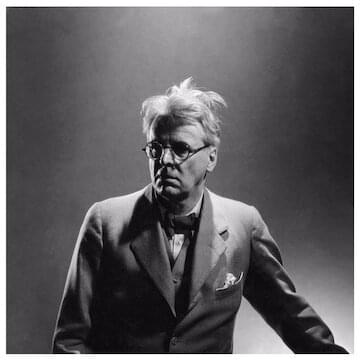
Born in Dublin, Ireland, in 1865, William Butler
Yeats was the son of a well-known Irish painter, John Butler Yeats. He spent
his childhood in County Sligo, where his parents were raised, and in London. He
returned to Dublin at the age of fifteen to continue his education and study
painting but quickly discovered he preferred poetry. Born into the Anglo-Irish
landowning class, Yeats became involved with the Celtic Revival, a movement
against the cultural influences of English rule in Ireland during the Victorian
period, which sought to promote the spirit of Ireland's native heritage. Though
Yeats never learned Gaelic himself, his writing at the turn of the century drew
extensively from sources in Irish mythology and folklore. Also, a potent
influence on his poetry was the Irish revolutionary Maud Gonne, whom he met in
1889, a woman equally famous for her passionate nationalist politics and her
beauty. Though she married another man in 1903 and grew apart from Yeats (and
Yeats himself was eventually married to another woman, Georgie Hyde Lees), she
remained a powerful figure in his poetry.
Yeats was deeply
involved in politics in Ireland, and in the twenties, despite Irish
independence from England, his verse reflected a pessimism about the political
situation in his country and the rest of Europe, paralleling the increasing
conservativism of his American counterparts in London, T. S. Eliot, and Ezra Pound. His work after 1910 was strongly influenced by
Pound, becoming more modern in its concision and imagery, but Yeats never
abandoned his strict adherence to traditional verse forms. He had a life-long
interest in mysticism and the occult, which was off-putting to some readers,
but he remained uninhibited in advancing his idiosyncratic philosophy, and his
poetry continued to grow stronger as he grew older. Appointed a senator of the
Irish Free State in 1922, he is remembered as an important cultural leader, as
a major playwright (he was one of the founders of the famous Abbey Theatre in
Dublin), and as one of the very greatest poets—in any language—of the century.
W. B. Yeats was awarded the Nobel Prize in 1923 and died in 1939 at the age of
73.
The Second Coming
%20copy.jpg)
The poet’s occult theory, as expressed in A Vision, is best summarized through his theory of the gyres, although he was not the first to present time, space and the very origins of being through opposites. The early Greek philosopher, Empedocles, had also developed a philosophy based on antithesis, as had William Blake. For Yeats, the whirling vortices are the foundation of all existence: ‘all physical reality, the universe as a whole, every solar system, every atom, is a double cone.’ (A Vision) One gyre expands as another contracts, always in a dialectical movement, crucially without ever succeeding to dominate, overcome or assimilate its Other: ‘the gyre of Concord diminishes as that of Discord increases… and so on, one gyre within the other always… as intersecting states struggling one against the other.’ (A Vision) Yeats saw the gyre as a model of history, time, personality. It was a 2,000 cycle, the end of which brought revolution, strife and turmoil for humanity. Following the First World War, the Russian Revolution (1917), the Easter Rising in Dublin (1916) and subsequent violence in the Anglo-Irish War (1919-1921) and the Irish Civil War (1922-1923), it is easy to see why the poet thought we were heading towards the apocalypse.
In A Vision Yeats
conceived of history as composed of two cones, rotating in opposite directions,
the apex of each at the centre of the other's widest arc. Every
moment in time moves through these opposing spirals. Any one moment thus
contains two antithetical, interpenetrating movements, for one cone is widening
as the other, whirling in the opposite direction, narrows. These spiraling
motions are the gyres. The times of maximum historical turbulence are those
where the gyres reverse their motions. These great historical reversals occur
every cycle of two thousand years (the 'Great Year'), at those moments where
previously expanding cone begins to contract and the previously contracting
cone to expand.
“The end of an age, which
always receives the revelation of the character of the next age, is represented
by the coming of one gyre to its place of greatest expansion and of the other
to that of its greatest contraction. At the present moment the life gyre is
sweeping outward, unlike that before the birth of Christ”.


LISTEN TO THE LECTURE ABOUT THE POEM:
DISCUSSION QUESTIONS
- Why do you think Yeats put so many confusing symbols in the poem? Many poets, when they use symbolism, try to make everything relate to each other. But what does falconing have to do with a sphinx or a "blood-dimmed tide," and what does either of them have to do with a sphinx and the "indignant desert birds"? Most people who read this poem want to make these things correspond to something real in the world. But we have to consider that Yeats did not want his poem to be interpreted in this way.
- How would you explain the poem’s relationship to the Bible? Most of the symbols are very general and timeless, like something out of the Book of Revelation. But it’s also easy to tell that this is not the Bible. For one thing, Christ doesn’t show up at the end, but a "rough beast." Does the poet sound like a religious man, and, if so, what kind?
- Why does Yeats think of history as this swirling vortex, the gyre? Because the gyre moves further and further from its center, does it mean that things are always getting worse? It should be mentioned that Yeats’s idea was highly original and not shared by everyone. There are still plenty of people, even today, who think that history is linear (except for a few blips like wars), and that society is constantly improving itself.
- Is it possible that the appearance of the "rough beast" could be good for the world, in the end? After all, if the world is already so violent that "innocence is drowned," things can’t get much direr. Maybe Yeats thinks it’s like tearing down an old building in order to put up a new one. But, then again, there’s nothing in the poem about society rebuilding itself.
- Do you think the poem could apply to the entire world, or is it only intended for Christian Europe? People in other civilizations, for example, the Middle East, have found this to be a very compelling poem, and they have made it fit into their own views of history. Maybe it speaks most directly to people with an "apocalyptic" outlook, who think that big, sweeping changes are on the horizon.
Check your understanding of the poem.
Quiz.
1. What man does not understand, he fears; and what he fears, he tends to destroy.
All empty souls tend toward extreme opinions.
There are no strangers here; Only friends you haven't yet met.
Education is not the filling of a pail, but the lighting of a fire.
By logic and reason we die hourly; by imagination we live.
If what I say resonates with you, it's merely because we're branches of the
same tree.
Do not wait to strike till the iron is hot; but make it hot by striking.
Any fool can fight a winning battle, but it needs character to fight a losing
one, and that should inspire us.
But I, being poor, have only my dreams; I have spread my dreams under your
feet; Tread softly because you tread on my dreams.
What can be explained is not poetry.
Words are always getting conventionalized to some secondary meaning. It is one
of the works of poetry to take the truants in custody and bring them back to
their right senses.
Literature is always personal, always one man's vision of the world, one man's
experience, and it can only be popular when men are ready to welcome the
visions of others
Things fall apart; the centre cannot hold.
The best lack all conviction, while the worst
Are full of passionate intensity.
We can only begin to live when we conceive life as Tragedy.
Be not inhospitable to strangers, lest they be
angels in disguise..


No comments:
Post a Comment
Note: Only a member of this blog may post a comment.