

BIOGRAPHY
Robert Frost: The Man and His Work
"Sometimes I have my doubts of words altogether, and I ask myself what is the place of them. They are worse than nothing unless they do something; unless they amount to deeds, as in ultimatums or battle-cries. They must be flat and final like the show-down in poker, from which there is no appeal. My definition of poetry (if I were forced to give one) would be this: words that become deeds."
"A poem begins with a lump in the throat; a home-sickness or a love-sickness. It is a reaching-out toward expression; an effort to find fulfillment. A complete poem is one where an emotion has found its thought and the thought has found the words."
"All poetry is a reproduction of the tones of actual speech."
"There are two types of realists: the one who offers a good deal of dirt with his potato to show that it is a real one, and the one who is satisfied with the potato brushed clean. I'm inclined to be the second kind. To me, the thing that art does for life is to clean it, to strip it to form"
Stopping By Woods on a Snowy Evening

Listen:

He once said that he wanted to write, "a few poems it will be hard to get rid of." Frost wrote one of his most famous poems, "Stopping by Woods on a Snowy Evening," at his home in Shaftsbury, Vermont in 1922. It was published the following year in a volume of poems called New Hampshire, which earned Frost one of the four Pulitzer Prizes he would receive in his lifetime.
Frost once said that “‘Stopping by Woods’ was his favourite poem because it arose from a particularly bleak Christmas and the ‘darkest evening of the year’ just before it. Having no money, Frost loaded the wagon with farm produce and went to town, but he found no buyers and returned empty-handed, without even small gifts for the children. He felt he had failed his family, and rounding a bend in the road, by woods, and quite near his house, the horse, who seemed to understand his mood, and who had already been given the reins, slowed and stopped, letting Frost have a good cry.” (David Hamilton, ʻThe Echoes of Frost’s Woods’, in Road Not Taken: Rereading Robert Frost, 2000, p.127).
Frost said that this poem is "my best bid for remembrance.". He also
said that he wrote this poem in a few minutes without any strain.
Here are some links to R. Frost's poem "Stopping by Woods".
Assignment
1. Comment on the title of the verse.
2. State the main idea of the verse.
II. Comment on the poetic features of the text.
a) rhythmical;
b) lexical;
c) stylistic.
III. Speak about the vocabulary of the verse, its morphological, semantic, and poetic features.
IV. State the grammar forms in the verse and comment on their stylistic value.
V. Pick out and give examples of a particular kind of rhythmical poetry based on reiteration of words and phrases. Say why they bring forth unexpected semantic effects. Don't forget about intensifiers "but", "and".
VI. Comment on detached epithets describing woods (lines 4, 13) farmhouse, line 6), promises (line 14), and miles (lines 15, 16). State their stylistic value.
VII. Speak about object images in the verse:
1. Give examples of metaphors, similes, repetitions in which the following associations are made: flakes, the wind, the horse, the only other sound, he and his, I sleep.
2. Say what connotations the words "sweep", "queer". "stop", "sleep" have for you.
3. Give examples of personification and exaggeration (hyperbole).
VIII. Comment on the devices which help to produce the musical effect and sometimes onomatopoetic-imitating sounds of nature:
a) alliteration in sounds and phrases;
b) punctuation in pair-rhymed lines, run-on lines, end-stopped lines.
IX. Characterize the key of the verse as lyrical, dramatic, epic, or grotesque. Comment on your choice.
X. Determine the tonal message of the verse as genial, sad, lyrical, or ironic. Say why.
XI. Summarizing your analysis don't forget to add:
- what you think the poet's purpose is describing this scene; what the author is trying to help us imagine; what you think about the poet's message; if it is cognitive, informative, or puzzling;
- how you understand the poet's symbolic representation and what it adds to the verse;
- what feelings this poem communicates to you. Are they named or expressed indirectly;
- what physical details are selected to suggest precise secondary meaning;
- which of the five senses (touch, taste, smell, hearing, sight) are exercised by the readers;
- that the poem was highly appreciated for its remarkable optimistic power and was awarded the Pulitzer Prize.
Questions
1. Why do you think Frost uses the word "woods" instead of "forest"? How are these two words different from one another?
2. Why does our speaker worry so much about who owns the woods?
3. Many people have criticized Frost for being too concerned with the past or with things that have nothing to do with the modern world (like radios and TV). Do you agree with this criticism? Can you relate to this poem?
4. Why do you think Frost titled this poem "Stopping by Woods on a Snowy Evening?"
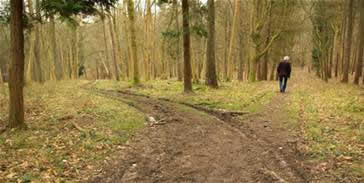
The Road Not Taken
Detailed Analysis
Study Guide
Analysis
Analysis 1
Analysis 2
Questions
1. What type of choices do you think this fork in the road represents for the speaker?
2. Do you think the road the speaker took was really the less traveled one? Why?
3. What do you think the chances are that the speaker will get to come back and try the other path?
4. Do you think the speaker regrets his choice, or is happy about it? Why?
Reflection Questions
- Life is full of a variety of choices. When can it
be beneficial to choose a path that is more traveled, rather than a path
that is less traveled?
- Who do you know who has chosen a ''road less
traveled,'' and what difference do you think it made for that person?
- What might cause someone to choose an unexplored
path over a well-marked path?
- How do you think the author feels about the
necessity of leaving one road behind?
- What types of choices do you consider to be easy?
What choices are more difficult?
- What factors do you consider when making an
important choice? How important is it to you to know what others have
chosen in the same circumstances?
- Is it really possible to know how specific
choices affect larger circumstances? Can you think of a time in your own
life that you know something would have gone differently if you had made a
different choice?


No comments:
Post a Comment
Note: Only a member of this blog may post a comment.